
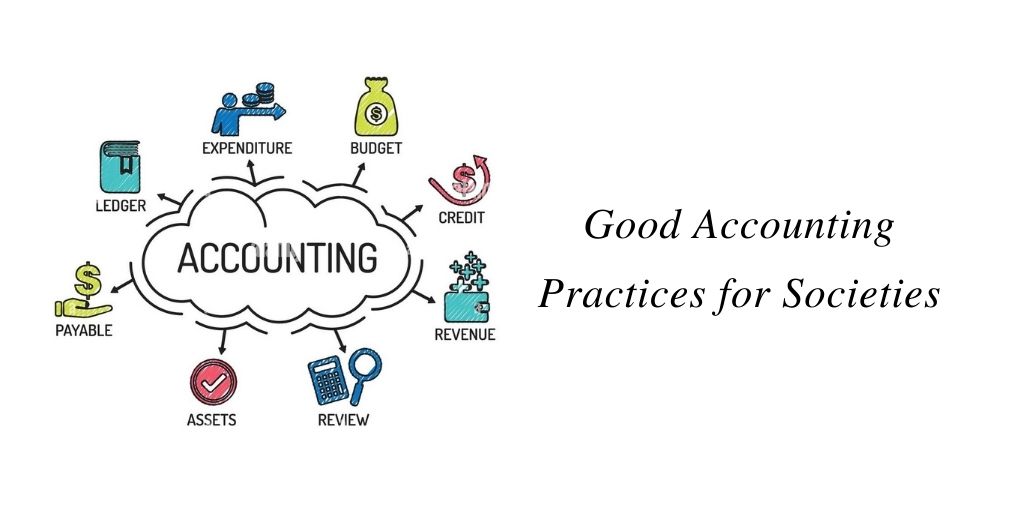
As discussed in article “Types of Registers to be Maintained by Cooperative Society“, societies are required to maintain proper records. In this article we are further detailing what are some of the goods practice in accounting, which we have learned over the years, if followed should help in ensuring efficient and accurate financial operations within a Society.
General Good Practice
- Use Accounting software to maintain books of accounts
- Use one accounting. We have societies using more than one software to manage accounts and having different data sets. For example: Accounts maintained in Tally but interest calculation done manually or excel.
- Use licenced and updated versions of accounting software. This will give access to updated features.
- Usage payment gateway for maintenance collection. This will reduce reconciliation efforts
- Use Audit Trail feature
- Daily Accounting
- Avoid accepting Cash and minimum cash payments
- Use QR Code issued by Bank for Maintenance and other receipt collection.
- Regular monitoring of accounts by Committee Members
- Proper filling of bills, vouchers and documents
- For delay interest prefer using percentage instead of fixed charges.
Yearly Exercises
- Budgeting at the beginning of the year for Operational expenses and Capital expenses.
- Getting books of account audited from Chartered Accountant.
Compliance
TDS Related
- Deduction of TDS from Vendor payment at the time of booking expense or payment to vendor, which ever is earlier.
- TDS Challan payment by 7th of every month to avoid delay interest @18% pa.
- Filing Quarterly TDS returns within due dates to avoid per day delay charges of ₹ 200/-.
- Update Challan details in accounting software.
- Generate TXT file for TDS Quarterly returns from accounting software.
GST Related
- Capturing proper GSTN of the suppliers and members.
- Capturing proper SAC code for supply of services.
- Capturing GST details at the time of booking voucher / expense.
- Calculating GST payments on Reverse Charge Basis (RCM) for Security Services, where ever applicable.
- Matching of Input credit 2A with books of accounts.
- Generating monthly challans for quarterly return / monthly return.
- Regular filing of GST returns within the due dates.
Income Tax Related
- Checking 26AS for proper TDS receivable updation (by banks for FD Interest, by members for TDS deducted on Maintenance and by Tenants for Lease Rentals etc).
- Checking Annual Information System (AIS) and Tax Information System (TIS) before filling Income Tax Return.
- Checking Electronic Credit Ledger and Electronic Cash Ledger in GST System.
- Filing Income Tax return within the due dates: for Audited Society (31-Oct) and for Unaudited (31-Jul).
Books of Accounts Related – Receipts Side
- Flatwise / Shopwise / Officewise / Plotwise Ledger name should be as per index of the current owners
- Ledger level complete details to be kept up to date
- Bill to bill should be activated
- Interest calculation (Delay Interest)
- Contact details
- Create below ledgers as different income heads
- Maintenance
- Shifting Charges
- Club House / Gym Charges / Lawn Charges etc
- Fixed Deposit Interest
- Interest and Penalties (collected from members)
- Lease Rentals
- Advertisement Income
- Flatwise invoice to be raised as per billing cycle with proper bill numbers and due dates. Once the invoices are generated, it should be shared with the member via email, hard copy etc.
- Update banking after reconciliation along with proper narration
- Include narration from bank statement
- Add additional narration with further details on period / purpose for which the funds are received. For Example: Maintenance for period Jan to Mar 2024, Club house charges for 25-Feb-2024 etc
- Knock off the receipt against proper bills
- All receipts should be generated through accounting software. Once generated should be shared with member on email / hard copy etc.
- Maintain proper records of Occupancy Status and billing to be done accordingly, if differential rates are charged.
- If there is change in occupancy status post billing, generate debit note or credit note and the same should be shared with member.
- Book all other incomes under proper heads (Shifting charges, Gym, Clubhouse, Lawns etc)
Books of Accounts Related – Payment / Expense Side
- Create Bank ledger and update cheque inventory against the same. Activate auto reconciliation
- Vendor wise ledger to be created
- Ledger level complete details to be kept up to date
- Bill to bill should be activated
- Contact details
- Update PAN and GST details
- Create different Expense Heads
- Electricity Expense
- Housekeeping Expense
- Security Expense
- MEP Expense
- Gardening Expense
- Lift – AMC and Repairs
- Fire System – AMC and Repairs
- Accounting Expense
- Audit Expense
- Repairs and Maintenance and others
- Update TDS applicability in Expense Ledger
- TDS on Contractor Payments
- TDS on Professional Fees
- Book Expense via Purchase vouchers
- Book Expense bill to bill
- Under proper expense head and vendor
- Apply TDS wherever applicable
- Fill in Proper narration along with cheque details
- After reconciliation update banking for all payments
- Include narration from bank statement
- Add narration from purchase voucher
- Knock off the entry against proper bills
- Update cheque number against proper inventory
- Generate all books of accounts from the accounting software on regular basis.
Filing
- Method of filing: Decide on one filling method and use the same for easy retrieval of documents. Filing can be as per
- Cheque number series. This is useful incase of single mode of payment and single bank
- Payment voucher
- Purchase voucher
- Attach Purchase or Payment voucher duly signed by Chairman / Secretary along with bills.
- Maintain all Credit note and Debit note duly signed by Chairman / Secretary
- Maintain separate files for
- Cash Payments
- Bank Payments (Cheque / Online) to Vendor
- Receipts / Credit note / Debit note
- TDS Challans and Quarterly Returns
- GST Challans and Quarterly / Monthly Returns
- Income Tax
- Audit
- Keep Scanned copy of the vendor payment documents. Some accounting software allows attaching scanned document along with booking of expense and other case same can be saved in Google Drive with monthly folders. This will help with easy and any time retravel instead of checking physical file. At year end or during audit, if any documents is not available in physical file, it will useful to get duplicate bill from vendor.
The Gujarat Cooperative Societies Act, 1961
Section 82.1
It shall be the duty of every society to keep the prescribed books of accounts with respect to all sums of money received and expended by the society, and the matters in respect of which the receipt and expenditure take place, all sales and purchases of goods by the society, and the assets and liabilities of the society, and to furnish such statements and returns and such records to the Registrar as the Registrar may by order direct from time to time; and the officer or officers of the society shall be bound to comply with the order within the period specified therein.

 Gujarat Cooperative Societies